As a palletizing robot supplier, I talk to facility managers, maintenance teams, and small business owners every week who share the same worry: “What happens if this expensive piece of equipment breaks down?” Palletizing robots are the workhorses of warehouses, distribution centers, and manufacturing lines that handle heavy loads, run 12+ hour shifts, and move millions of units a year. When one goes down, it doesn’t just mean a repair bill—it means missed deadlines, idle staff, and lost revenue. That’s why one of the most common questions I get is: Are palletizing robots easy to repair? The short answer is: It depends, but when designed and supported properly, they’re far easier to fix than most people assume. Palletizing Robots
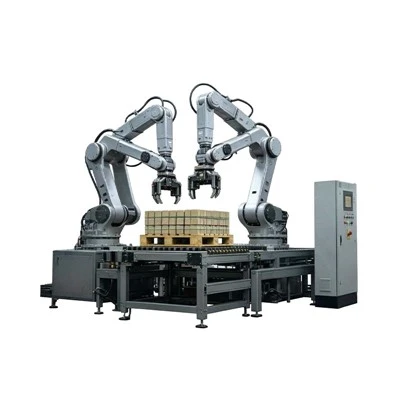
Let’s start by demystifying what a palletizing robot actually is. Most standard industrial palletizing robots used today are 6-axis articulated robots—they have a rotating base, a shoulder, elbow, wrist, and end effector (the part that grips boxes, bags, or drums) that can reach every position on a pallet. Their core systems are fairly straightforward compared to older, custom automation setups: a mechanical arm, a motor system, a controller (the “brain” that runs the robot’s path), and software that coordinates movement. None of these components are unique or proprietary in a way that makes repairs impossible for qualified technicians.
The biggest myth I hear from new customers is that palletizing robots are so complex only the original manufacturer can fix them. That’s partially true if you’re dealing with a custom-built, 20-year-old model that uses obsolete parts, but for most modern palletizing robots—including the ones we supply—repairs are accessible to three groups: in-house maintenance teams, third-party industrial automation technicians, and our own on-site support teams. We train a lot of customers’ maintenance staff on basic repairs because it cuts downtime and lowers long-term costs. For example, a common issue we see end users fix themselves is a worn end effector gripper. The rubber or mechanical fingers that grip boxes get damaged from daily use, especially with uneven surfaces or heavy loads. On most models, the end effector is designed to be swapped out in under 30 minutes with basic tools—no specialized training required. We include step-by-step replacement guides with every robot, and our support team walks new users through their first swap over a quick call. That’s not a “trick”; it’s intentional design to reduce downtime.
Of course, not all repairs are that simple. What about more serious issues, like a faulty motor or a misaligned arm? Here’s where the ease of repair comes down to how the robot is built. Modern palletizing robots use standardized parts from major suppliers—motors from Siemens or Fanuc, controllers from Allen-Bradley, belts and gears from industrial brands that sell parts to any automation shop. That means you don’t have to wait weeks for a custom part from a single manufacturer; most replacement parts are in stock from distributors within 48 hours. Last year, we had a customer in Ohio who had a motor fail on their palletizing line during a peak holiday season. They ordered the replacement part from a local industrial parts supplier, and their in-house maintenance team installed it in 2 hours. If it had been an older, proprietary model, that same repair would have taken 3 days waiting for a part and 2 more days for a manufacturer technician to show up. That’s a huge difference for a business that can’t afford downtime during their busiest period.
But there’s a catch: ease of repair only works if the robot is maintained correctly. I’ve seen way too many customers put off routine checks because they think their robot is “set it and forget it,” and end up with a major breakdown that’s far more expensive and harder to fix. For example, failing to lubricate the arm joints every 6 months leads to increased friction, which can wear out a gear or motor prematurely. That repair isn’t impossible, but it requires disassembling part of the arm, which takes longer and costs more than a simple lubrication routine. Routine maintenance is the biggest tool you have to keep repair needs simple and infrequent.
Another factor that affects repair ease is the level of support your supplier provides. As a palletizing robot supplier, we don’t just sell a machine and walk away. We offer two layers of support: remote troubleshooting, which lets us diagnose most issues over a call or screen share, and on-site support for more complex problems. For example, if a robot is making unusual noises or not moving to the correct positions, our team can log into the robot’s controller remotely to check for software glitches, misaligned code, or sensor issues. More than 40% of the problems we see with palletizing robots are software-related, which can be fixed in less than an hour without anyone having to step foot on-site. That’s a game-changer for small businesses that don’t have a big maintenance budget or a technician on staff.
I also want to address the elephant in the room: what if you’re a small business with a limited budget and no in-house maintenance? For these operators, palletizing robots are actually easier to repair than manual palletizing lines, which require constant repairs on forklifts, conveyor belts, and manual lifting equipment. A manual palletizing line has dozens of moving parts that can break daily—forklift tires, conveyor belts, hydraulic lifts—each requiring their own specialized repair. A palletizing robot, by contrast, has a small number of high-quality, standardized parts that rarely need replacement. On average, a modern palletizing robot has a mean time between failures (MTBF) of over 80,000 hours, which translates to around 9 years of continuous operation before a major repair is needed. That’s far more reliable than most manual or semi-automated palletizing setups.
Of course, no equipment is immune to damage. Accidents happen—forklifts bumping into the robot arm, heavy loads dropping on the end effector, power surges damaging the controller. When these issues do occur, the key to easy repair is design. We build all our palletizing robots with modular components, meaning each part of the robot is a separate unit that can be swapped out without rebuilding the entire machine. For example, if a power surge damages the controller, you don’t have to take apart the arm or rewiring the entire line; you just replace the modular controller, plug in the new one, and reload the software settings. This is in contrast to older robots that have integrated components, where a single damaged part requires tearing apart half the machine.
I’ve seen firsthand how different repair experiences can be between a quality-built palletizing robot and a lower-cost, no-name model sold by unvetted suppliers. Last year, we took on a customer who had bought a budget palletizing robot from a supplier who went out of business six months later. When their robot’s wrist joint failed, they had to search for a third-party part that no longer made the exact component, and technicians had to modify parts themselves to make it work. The repair ended up costing them twice as much as a new robot would have, and they were down for two weeks. That’s why choosing a reputable supplier that stands behind their equipment is just as important as the robot being easy to repair. A good supplier will provide access to parts, training, and support long after the sale, so you’re not stuck when something goes wrong.
So, to circle back to the original question: Are palletizing robots easy to repair? The answer is yes, if you choose a modern, well-built model from a reputable supplier, follow a routine maintenance schedule, and have access to support and standardized parts. They’re not as simple as a consumer appliance you can fix at home, but they’re far more accessible than most people realize, especially compared to older automation or manual palletizing systems.
For businesses that are still on the fence about investing in a palletizing robot, the repair factor shouldn’t be a reason to hold back. The downtime savings from a reliable robot far outweigh the cost of occasional repairs. And when you work with a supplier that prioritizes repairability—modular parts, standardized components, training and support—you get a machine that works for you, not against you, even when something breaks.
If you’re ready to learn more about our line of palletizing robots and how we can support you with repair resources, training, and ongoing support, we’d love to connect. Our team has helped hundreds of businesses optimize their palletizing lines, reduce downtime, and lower long-term costs. Don’t let repair concerns hold you back from upgrading your operations. Contact our team today to discuss your specific needs and how our palletizing robots can work for your business.
Pipe Support Brackets References
- Industrial Robots: Repairability and Maintenance Best Practices. Robotic Industries Association.
- Mean Time Between Failures (MTBF) for Industrial Automation Equipment. Automation World, 2022.
- Modular Design in Industrial Robots: Benefits for Repair and Downtime Reduction. Journal of Manufacturing Engineering, 2021.
- Third-Party vs. Original Equipment Manufacturer (OEM) Repair Costs for Palletizing Systems. Logistics Management, 2023.
Wanyuan Yuanwei Automation Equipment Co., Ltd.
With abundant experience, we are one of the most professional palletizing robots manufacturers and suppliers in China. Please feel free to wholesale high quality palletizing robots for sale here from our factory. Good service and punctual delivery are available.
Address: No. 392, Wanbai Road, Baisha Town, Wanyuan City, Dazhou City, Sichuan Province
E-mail: wanyuanyuanwei@outlook.com
WebSite: https://www.yuanweiautomation.com/
